Silent Drowning: Why It's So Easy to Miss
Most people who drown in a poolnever call for help. There's no shouting, no waving, nothing that pulls alifeguard's eyes to one spot in the water. It can look like someone standingchest deep, floating quietly, playing, or simply practicing holding theirbreath underwater, itself a real risk known as shallow water blackout. Missingthe real thing usually doesn't take carelessness. It takes a few seconds oflooking somewhere else.
That gap between what adrowning looks like and what people expect to see is a big part of why it keepshappening in full view of other people. Not because no one was around, butbecause no one saw anything that looked like trouble.
Why silent drowning is so easy to miss
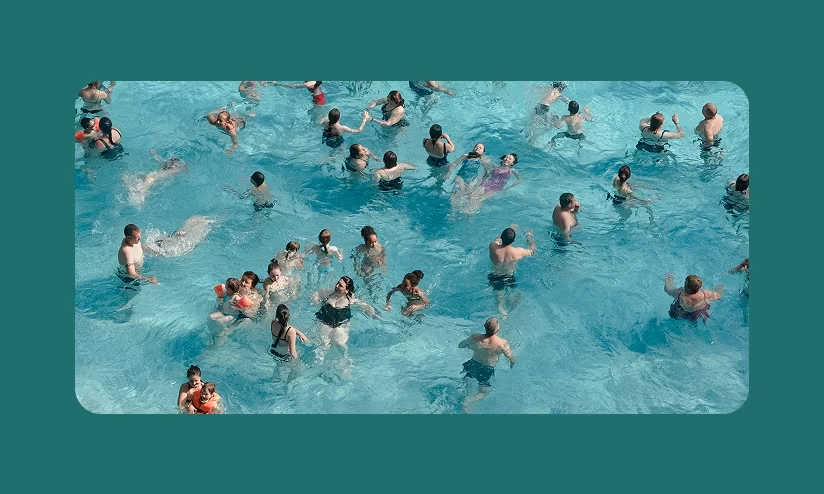
A person drowning in a pool isusually fighting to keep their mouth above the surface, not trying to getattention. There is no air to spare for shouting and no strength left over towave. From the pool deck, what's visible is often just a body riding low in thewater, a head tipping back, going under for a second and coming back up, thengoing under again. To someone glancing over, it can look like play, or someonecatching their breath, or nothing worth a second look.
Researchers have documentedthis pattern for decades. Lifeguard trainer Francesco Pia described it as the instinctivedrowning response (IDR) after reviewing hours of film of realdrownings in the 1970s. Not every drowning plays out exactly the same way, butthe common thread holds across most of them: the person in trouble makes farless noise and far less movement than people expect, right up until they gounder.
Dr. Leana Wen, an emergencyphysician and CNN wellness medical expert, put it plainly in a recentinterview: drowning is often surprisingly quiet, because a childstruggling in the water is focused entirely on trying to breathe. She notedthat a person in trouble may bob vertically, appearing to climb an invisibleladder, or simply slip beneath the surface.
This can happen in as little as20 seconds and rarely takes longer than 60 before the person goes under. At abusy pool, that is barely enough time for anyone to notice something is wrong,let alone reach them.
Drowning deaths are rising again
In 2024, 1,075 children andadolescents under 20 died from unintentional drowning in the US, according to CNN's reporting on the latest data.
Pediatricians are watching thepool and backyard numbers closely too. A 2026 American Academy of Pediatrics technical report,reviewing decades of evidence on drowning prevention, points to disrupted swimlessons and reduced pool access during the pandemic as possible drivers, andwarns that the decades-long decline in child drowning deaths before 2019 hasreversed.
Where AI fits into a silent problem
Human attention has limits thathave nothing to do with how much a lifeguard cares about the job. Research onsustained vigilance shows focused attention starts degrading after 20 to 30minutes on the same task, and a busy pool deck adds constant interruptions ontop of that. Quiet distress in the water doesn't produce the loud, obvioussignal that untrained attention is primed to notice, and that's true even forattentive, well trained lifeguards on their best day.
This is the exact gap AImonitoring is designed to close. Rather than waiting for a splash or a shout,systems like Lynxight are trained to recognize the subtler signs that someoneis in trouble in the water: minimal movement, a body riding low, a head thatkeeps dipping under without fully coming back up. When that pattern appears, analert goes to the lifeguard immediately, with a location, so their attentiongoes exactly where it's needed. It doesn't replace supervision. It extends itto cover the moments no one happened to be looking.
Silent drowning is dangerousprecisely because it asks the human eye to catch something it isn't built tocatch reliably, every single time, for hours on end. That's a problem worthsolving with more than good intentions.
.png)