What a day at Freeflow taught me about where UK swimming is heading
.png)
Dan Brazil,Lynxight — Freeflow Swim Conference, London Aquatics Centre
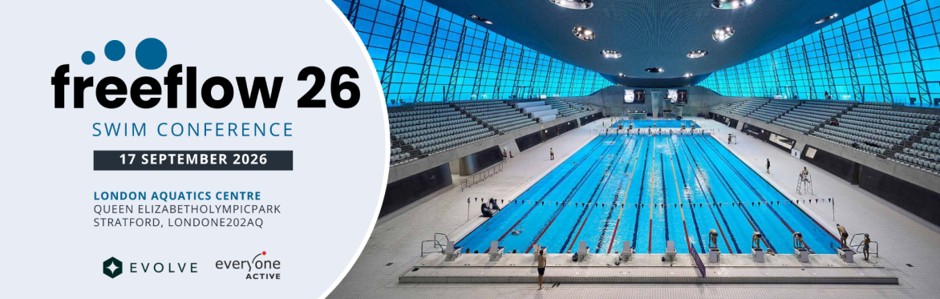
If you’d asked me on the train home what surprised me most about this year’s Freeflow Swim Conference, it wouldn’t have been any single statistic, and there were plenty. It was how little time anyone spent arguing about whether people want to swim. They do. A hot summer pushed attendance up by roughly 30% at some operators, and Steve Parry, UK aquatics’ answer to John Bishop, got five panels’ worth of governing bodies, operators and suppliers to agree the sector is speaking withone voice for the first time in years.
The harder conversations were about everything around the water: a funding model quietly running out, an ageing estate, energy bills most operators admit they don’t fully understand, and pools that look busy from the balcony but aren’t usednearly as well as they could be. Whatever the problem, everyone gave the same answer. Understand it properly first. Measure it.
Freeflow is the curtain-raiser for EVOLVE’s State of the UK Swimming Industry Report 2026, 128 pages of independent research, and the day had the feel of an industry hearing what its own numbers have to say about it.
Here are the five ideas that stayed with me:
1. The sector has never been more united. Its pools have rarely been in worse shape.
Panel: State of the UK Swim Industry — Steve Parry (Swim!,host), Rebecca Cox (Swim England), Dave Candler (STA), Simmy Akhtar (RLSS),Andrew Clark (GLL)
Every panellist opened with the same one-word mood: optimistic. The Swim Alliance and its task force have put operators and national bodies on the same stage and infront of government together. As one panellist put it, “You didn’t used to sit here as a panel. We’re all shouting with the same voice.”
The optimism came with a heavy qualifier: “We’re sitting here in a state where most of our pools aren’t in a fit condition.” A swim has cost operators about £10 todeliver since free swimming for under-16s and over-60s arrived in 2008. Nobody has charged £10 since, and the cross-subsidy that used to come from gyms and lessons has been eaten away. “It’s not about putting the price back onto the customer. Our baseline costs have gone up, our pricing has stayed the same, and the local authority tells us to hold it. It’s about funding.”
Hanging overthe session was the BBC’s finding that one in four children leave primary school unable to swim. Asked whether a system that fails a quarter of its children can honestly be said to work, the STA’s answer was “quite simply, no. ”The RLSS added something worth sitting with: many of the people who drown would have passed their national curriculum outcomes. Getting children to the wateris only half of it; what they’re taught once they’re in is the other half.
2. The market is moving faster than a once-a-year report can follow.
Panel: The Changing Face of UK Swimming: What the Data Tells Us About Its Future — Dan Harrison (EVOLVE, host), Jamie Buck (EVOLVE,Head of Research)
“The swim report has been the same format for 23 years,” Jamie Buck told us, and this year breaks with that. Between the data cut-off at the end of July and the conference, EVOLVE had already logged more than 100 further pool developments,and now expects to track 100 to 200 openings, closures and operator changes every month. A decade-long debate over a 12% loss of pool stock since 2010 looks different against a near-live picture.
Nearly half the country’s public pools are now run by trusts, and there’s a whole shadow estate of school pools that doesn’t appear in the public count because it allows no public access at all. “The more access we give people, the better,”Dan Harrison said. “There are a lot of pools we could reach out to and ask, can we manage this differently?”
The moment that landed hardest needed no data. Standing in the building the 2012 Olympics built, the room was asked to raise a hand if they thought the UK had honoured its swimming legacy. Most hands went up for no.
3. The cheapest unit of energy is the one you never use. Most operators don’t know how much they use.
Panel: Energy Costs – The Solution — Dan Harrison (EVOLVE,host), Adam Wright (directOS), Mike Worsnop (Leisure Energy), Tom Lloyd(RenEnergy)
Live polling opened the energy session, and the results were uncomfortable: a good share of the room didn’t know when their energy contract was due for renewal, and guesses on broker fees ranged from a penny to more than twenty per pound. The panel’s first piece of advice was one I recognised from my own world: start with the data. “I could count on one hand the people who truly understand the energy they consume, what they pay for it and when they use it. Get your half-hourly metering. Then you’ve got a fighting chance.”
Forced to choose between buying energy better, using less, or generating their own, the panel chose using less, and pointed to kit already sitting unused on leisure centre roofs. “We’ve found fifteen-year-old solar arrays running twenty percent down because they’re filthy or an inverter has failed, and nobody on site knew.”
I asked the panel from the floor, something we’re exploring at Lynxight: could occupancy data connect systems that don’t currently talk to each other? We’re trialling a link between real-time bather counts and filtration drive speed, since filtration is the most expensive plant in the building after heating and rarely needs to run flat out. Their view: a pool’s energy demand naturally rises and falls through the day, and the sector has barely begun to run its plant that way. The plant should follow the people, not the timetable.
4. A full pool isn’t necessarily a productive one.
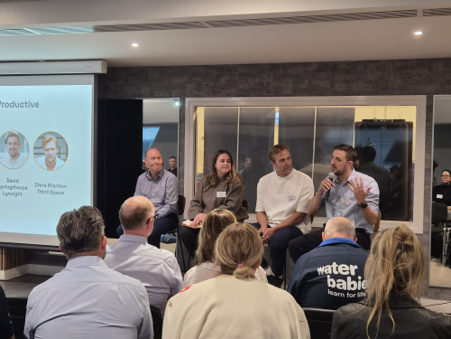
Panel: Measuring and Making Pools Productive — Steve Parry(Swim!, host), Ian Cotton (Everyone Active), Chloe Efford (Horizon), DavidSpringthorpe (Lynxight), Chris Stanton (Third Space)
Steve asked what “productive” actually means for a pool, and the room split almost evenly between occupancy, revenue, participation, experience and social impact. Everyone Active’s unique customer IDs have revealed that around 70% of their lane swimmers are also fitness members, and that swimmers stay members longer. Horizon was honest about where measurement runs out: “We know who booked. We don’t know how long they were in the pool, who dropped out, or why.”
That gap is where my Lynxight colleague David Springthorpe took the conversation. “If you’ve got an hour-long booking but people are only in the water for 40 minutes, you’ve got a productive pool for 40 minutes and a gap for 20. We can now show not just who scans in, but how long they’re in the water and, in aggregate, what they’re doing.” A heat map by hour, day and month has a habit of finding quiet water in pools everybody assumed were full.
The line that got the biggest reaction was David’s too: “Gym floors look nothing like they did fifteen years ago. When I stand on the gym floor and look down at the pool, it looks exactly the same. Slow lane, medium lane, fast lane. It feels like the forgotten part of the building.”
The panel agreed on where growth sits: health, rehabilitation and simply moving in water for people who may never swim a length. “That’s where the money is,” Ian Cotton said. “That’s where the government departments have the money.” David closed the session with something I hear from operators most weeks, though they rarely put it this bluntly: “An operator this week described themselves asunconsciously incompetent. They don’t know what they don’t know. Build the baseline first, and a whole new world opens up.”
5. The public money isn’t coming back, so swimming has to learn to prove its worth in pounds.
Panel: Socio Demographics of Swimming — Adrian Turner(ReCreation, host), Alexa Passingham (EVOLVE), Andy Farr (Parkwood), AlexScott-Bayfield (Fitmedia), Andy Kidd (Swimathon)
Alex Scott-Bayfield’s run through a decade of Active Lives data was blunt. Adult swimming is around 400,000 people below where it was in 2015–16, roughly 400 pool sites have gone, and there’s no clear relationship between Sport England funding and either facilities or participation. Then she said something that shut the room up: “Before the last election we were asked to put policy recommendations to any incoming government. It was made very clear that whatever we proposed had to be resource neutral. No one was going to put serious money into this sector.”
Turn the same numbers round and there’s an opportunity the sector rarely talks about. Between 25 and 30% of adults in this country can’t swim, about 10 million people. Persuade one in ten into the water regularly and you’ve added a million customers. Parkwood’s discounted swim schemes mean people from the poorest 10% of neighbourhoods are now their single biggest group of swimmers; their learn-to-swim programmes are more ethnically diverse than the communities they sit in, but everything else they do in the pool isn’t. Once someone has learned to swim, the industry’s only message to them has ever been “come and swim.”
And one number I wrote down: getting a completely inactive person to moderate activity carries an economic value of around £4,600. “Take 100 people who never exercised and get them swimming once a week,” Alex said, “and you’ve created £460,000 of social value. That’s a figure for the Department for Work and Pensions, not just Sport England.”
Where I landed
I came into this industry at the start of the year, and days like Freeflow are where a lot of my education happens. What I heard, over and over, was a sector learning to describe its value in evidence rather than sentiment: who is in the water, for how long, doing what, and what that’s worth in pounds to the people who hold the budgets.
Lynxight started as a lifeguard-support company, and the first job of a productive poolis still a safe one. But the same system that watches for a swimmer in trouble now gives operators the clearest picture of pool utilisation they’ve ever had. Freeflow left me convinced that picture now sits underneath everything else: safety, energy, programming and the financial footing the sector has to build for itself.
If you’d like to know what your pool’s data actually says, I’d love to show you. And the State of the UK Swimming Industry Report 2026 is now available to download.
Freeflow Swim Conference is produced by EVOLVE Global Intelligence with Everyone Active and hosted by Steve Parry.